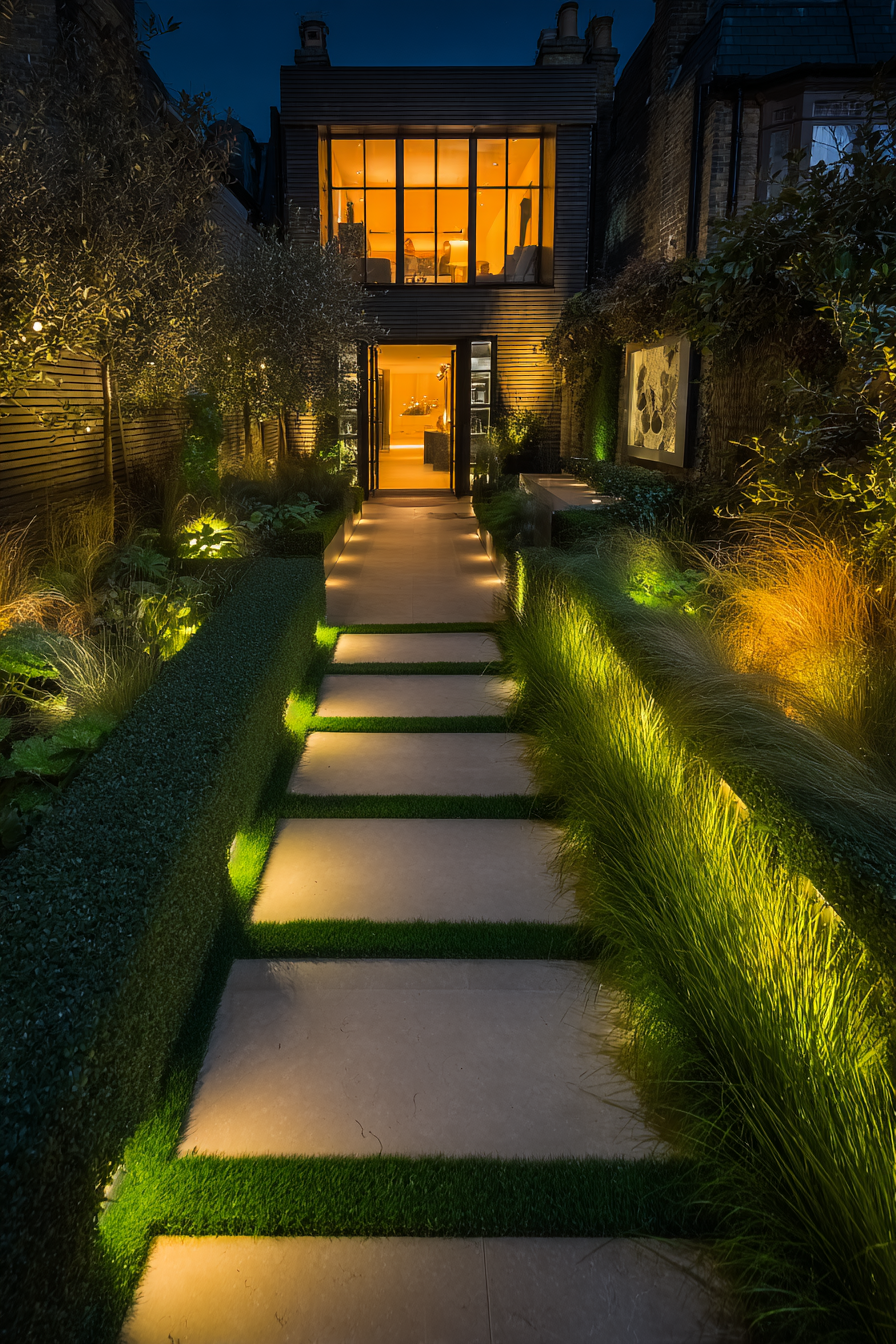
Most gardens disappear at night. You spend months planting borders, shaping paths, choosing trees and arranging pots — and then as soon as the sun goes down, it all vanishes into darkness. Good garden lighting changes that completely. It turns the garden into something you can still enjoy long after evening arrives. More than that, it changes the atmosphere entirely.
A garden during the day is about colour, texture and planting. At night, it becomes about glow, shadow, shape and mood.
The interesting thing is that garden lighting does not usually work best when it is brightest. The most beautiful gardens at night tend to use light quite gently. A few carefully placed lights often create far more atmosphere than flooding the whole space.
One of the simplest but most effective tricks is uplighting trees from below. A weeping willow, olive tree, acer or silver birch suddenly becomes dramatic once lit from the base. The branches cast shadows, leaves glow softly overhead and the whole garden feels deeper and more layered. Even a relatively small tree can suddenly feel architectural after dark.
Architectural plants work beautifully with lighting too. Tall grasses, agapanthus, palms, tree ferns and clipped shrubs all create strong shapes once the light catches them. Grasses move in the breeze and throw soft shadows. Structured plants create contrast and definition. Lighting turns planting into sculpture.
Borders can be lit differently depending on the feeling you want. Warm low-level lighting hidden amongst flowers creates a softer romantic effect, particularly around roses, hydrangeas and cottage garden planting. Cooler white lighting tends to feel more modern and contemporary, especially in minimalist gardens with clean paving and structured greenery.
Path lighting changes the feel of a garden as well. Small lights placed low beside gravel, stepping stones or pathways make the garden feel inviting and calm. They guide the eye naturally through the space without needing harsh brightness. Even a very small garden can feel more expensive simply because the paths are softly lit.
Water changes completely at night too. A pond with reeds lit from below becomes reflective and atmospheric. Light bouncing across moving water creates depth and movement in the garden that you simply do not notice during the day. Even a small water feature can suddenly become the focal point after sunset.
Wall lighting creates another layer. Brick walls, fences and rendered surfaces all react differently to light. Warm lighting against red brick feels traditional and cosy. Light washing softly across pale rendered walls creates a Mediterranean feel. Trellis, climbing roses and espalier trees become more noticeable once shadows start appearing behind them.
Then there is the seating area itself. This is where people often get lighting wrong by relying on one harsh overhead light. Softer layered lighting almost always feels better outdoors. Lanterns, table candles, festoon lights, hidden uplighters and subtle lighting around planting make people want to stay outside longer. It feels calmer and more relaxed.
One of the nicest things about garden lighting is that it changes the way the garden is used. A garden that felt purely practical during the day suddenly becomes somewhere to sit quietly with a drink, have dinner outside or simply look at through the windows in the evening.
You do not need a huge garden either. Even a small patio, courtyard or balcony can feel atmospheric with the right lighting. A few pots, one tree, warm lighting and somewhere comfortable to sit can completely change the mood of a space.
The best garden lighting rarely announces itself. Instead, it quietly makes everything else look more beautiful.